
The Massachusetts Immigrant Collaborative is grateful to you, our supporters, for helping us to empower 4,441 people from immigrant communities. On behalf of all 15 Collabora tive partners, thank you!
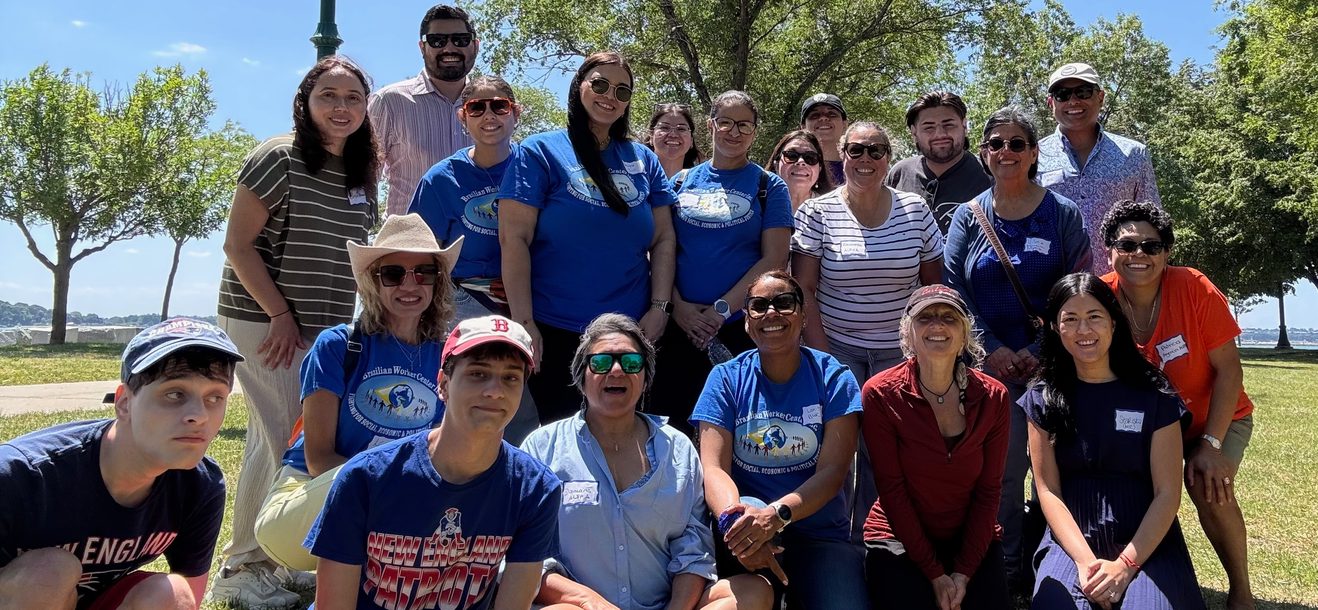
We began 2024 by coming together for our annual retreat and spent the day sharing our accomplishments, what we learned in 2023, and how these learnings will shape our priori ties going forward. Most importantly, we heard about each other’s successes, challenges,
the communities each of us serves and how each partner supports and empowers them. Some serve as welcome centers for newcomers arriving daily, connecting them to shelter and resources. Several offer hunger relief including bulk food distribution and meals; and others provide education and leadership opportunities for young immigrants. We learned about the need to advocate for workers’ rights and educate immigrant workers experienc ing wage theft and other exploitation. In 2023, migrant farm workers in the western part
of the state lost jobs when record-breaking floods destroyed farmland during the summer growing season. Our partners in the Pioneer Valley were there to support them. Through out Massachusetts, whether greater Boston, Middlesex County, Pioneer Valley or New Bedford, our partners are working with a growing immigrant population in need of hous ing, health and other services.
Our take-away is that working together, our 15 partner organizations can learn from each other, sharing knowledge, skills and best practices, and can advocate more powerfully for fair immigration policies. Today, the five priorities we identified two years ago remain just as relevant. In 2024 we will continue to support individuals and families in urgent circum
stances by providing emergency cash and food assistance. Our immigration legal services and workforce development programs will empower immigrants seeking stability and better futures. We will work to build capacity of each partner organization. Finally, we will increase our advocacy efforts and have launched a working group to determine how the Collaborative can best impact policies that affect immigrants. Together, we will work to ward a better future for all our community members.
Immigration Legal Services educate and empower
For some people, applying for legal immigration status can mean the difference be tween a work permit and safe place to call home, and deportation to dangerous cir cumstances, political unrest or economic challenges. Access to legal counsel can dras tically increase a person’s chances for a successful case outcome, yet many cannot afford an attorney.
In collaboration with our legal partners, Rian Immigrant Center, Mabel Center for Im migrant Justice, and Agencia ALPHA; and Immigrant Family Services Institute, who is joining us in this work in 2024, we provide Centralized Immigration Legal Services, to
which our partners can refer low-income and underserved community members for a free confidential legal consultation. Consultations can educate them about available legal options. Getting advice from experienced attorneys and Department of Justice (DOJ) accredited representatives who are authorized to practice immigration law helps clients avoid notarios or other people who offer assistance but are not authorized to practice law. Following consultations, our legal partners accept cases for full represen tation as capacity allows, or share additional resources.
In 2023 we provided 857 consultations to community members, and full representa tion to 307. The majority of cases were straightforward applications including work permits, and Temporary Protected Status. Though much less time intensive than some other types, they can have a huge impact, enabling people to remain in the US and support themselves and their families. Other cases like asylum, Violence Against Wom en Act, U Visa (victims of crime) and Special Immigrant Juvenile Status (children who cannot reunify with their parent(s) due to abuse, abandonment or neglect); are more resource and time intensive. They are also critically important.
“Roseline”, referred by the Brazilian Workers Center, shared her experience apply ing for a visa with support from the Collaborative’s Centralized Immigration Legal Services. Says Roseline, “I know it’s going to be a long process but Beverly [my attorney from Rian] is making it better. [She is] always very attentive [and] always keeps me informed as to what’s going on. It’s been extremely positive. Because I have a young child, [having legal services at no cost] helps me a lot. If I had to pay, I wouldn’t be able to go through with the process.”
When asked what a potential pathway to legal status means to her, Roseline says, “I have the opportunity to get a work permit, and pay taxes, and have an income. I [could] go back to my country… and visit my friends. My mom … could come, and she could meet her grandchild. Things like that make me very happy.”
Roseline shares her message to the Collaborative, its legal partners and communi ty: “[I would like to express] gratitude [from] me and my family, for everything that has been done. To have hope… that doesn’t really have a price.”
Immigrant Economic Recovery Initiative:
Working toward sustainable futures
In 2023 the Collaborative began a partnership with the City of Boston and launched the Immigrant Economic Recovery Initiative, a year-long program empowering 200 immigrant community members in Boston. Participants will receive monthly basic needs assistance, case management and opportunity cost funding for language and workforce training. Equally important, families acquire savings to help them with stand future financial shocks after the program, as well as with language skills that will outlast any program timeframe and jobs training and financial literacy skills.
After extensive outreach and recruitment, we have identified 200 eligible families and individuals from a broad range of cultures, countries of origin, and Boston neighbor hoods. Each has been paired with a dedicated case manager tasked with facilitating access to educational opportunities, conducting goal-setting workshops, assisting with the opening of bank accounts, and connecting participants with additional resources. We eagerly anticipate supporting these new immigrants as they strive for a more sta ble and sustainable future.
A research and evaluation team has also been engaged to also help track the long term effects of this program beyond the 12-month period on financial empower ment and mental and physical wellbeing. Leading this aspect of the initiative is the Leah Zallman Center, a local non-profit specializing in immigration research.
The Collaborative welcomes new staff

The Collaborative is pleased to welcome (L toR) Guerlince Semerzier who joined us as ProgramDirector for the Immigrant Economic RecoveryInitiative early this year; and Anna Flores-Amper who is our new Immigration Legal Services Program Manager. We congratulate José Maza on his new role with Rian Immigrant Center’s development team.
Emergency assistance remains essential for immigrant families
When the pandemic began and our 15 partners came together, our main concern was to provide cash and food assistance for families in urgent circumstances. While our focus and programs have expanded, emergency assistance remains a critical need for many.
In 2023, the Collaborative and its partners provided food and emergency cash assistance to 3,590 immigrant families who were experiencing economic hardship. Close to 90% were struggling to pay rent and utilities, and buy food and groceries. Other needs included medi cal and childcare expenses.
Said one recipient, “These resources have made the difference between being housed and unhoused, access to medicines and critical medical care, childcare, and legal services. The significant and necessary work of M.I.C. is sacred work and our families are deeply grateful as we work for a society in which everyone has what we need for lives of dignity and flour ishing. Thank you!”
In 2023, increasing numbers of immigrants came to Massachusetts, most seeking escape from violence and political unrest. The partner organizations which comprise the Massachu setts Immigrant Collaborative, in conjunction with the State, are doing their best to support these families, connecting new migrants to needed resources. The Collaborative stands be hind our partners and through our emergency assistance for new migrants program have provided funding to support them in this work.
The big picture: Advocating for a better future
Looking ahead, the Collaborative seeks to continue its advocacy for policies and better en forcement of existing laws to ensure immigrants are treated with dignity, equity and have a fair chance of building sustainable and successful lives. Many of our partners are working on a range of issues around which we plan to become better aligned. We anticipate coming to gether with more frequency for planning that impacts policies as well as public perception. Additional suggestions from our retreat include reclaiming and restoring the public narrative about immigration; building upon our previous successes in policy advocacy and raising pub lic awareness; and exploring how we might work more strategically with the federal govern ment and how they engage with policy and public opinion regarding immigrants.
Gratitude to our supporters
We are so very grateful for support from our donors in 2023, including the Klarman Family Foundation, Liberty Mutual Foundation, The Boston Foundation (through the Executive Office of Housing and Economic Development’s Community Foundations Grant Program for COVID-19 Relief), Cambridge Community Foundation, United Way of Massachusetts Bay, TJX Foundation, and many others whose support enables us to work alongside immigrant fami lies and individuals across Massachusetts.
Partner Members of the Collaborative
The Massachusetts Immigrant Collaborative includes 15 partner organizations statewide working in solidarity with under-resourced immigrant communities. Working together; we share ideas, networks, experience, funding and other resources; and support each other in our work.
José Claudio, from New North Citizens’ Council (NNCC – Springfield) and Stephen Hunter from Boston Chinatown Neighborhood Center (BCNC) share their experiences as M.I.C. partners.
“Mass Immigrant Collaborative has been instrumental for our agency to help the immi grant community get their needs met as they deserve. It has been a blessing for the city of Springfield for NNCC to be partnered with M.I.C. so that we can advocate, build capacity, and provide workforce development that is so much needed in the immigrant community. I cannot be happier to be part of this organization.” – José Claudio, NNCC
“The Collaborative is really important for BCNC because it brings together like-minded or ganizations who are dealing with the same issues and struggles in the community. It’s real ly great to collaborate and share resources, experiences and expertise. I can say that I am
proud that BCNC is a member of the Collaborative. Working with other partners, we can serve the immigrant community at large.” -Stephen Hunter, BCNC
You can learn more about our partners by visiting their websites.
- Agencia ALPHA
- Boston Chinatown Neighborhood Center
- Boston International Newcomers Academy
- Brazilian Worker Center
- Caribbean Youth Club
- Centro Comunitario de Trabajadores
- Centro Presente
- Dudley Street Neighborhood Initiative
- ICNA Relief
- Immigrant Family Services Institute
- MetroWest Workers Center: CASA
- New North Citizen Council
- Pioneer Valley Workers Center
- Rian Immigrant Center
- Sociedad Latina